

Decolonized Presence and Possessed Pork
A Lectio Reflection on Mark 5:1–20

Sarah Skinner, Kaleidoscope Institute, June 2025
We begin with sacred reading—a threefold encounter with the text
(As part of this practice, you will read this text three times)
Mark 5:1–20, NRSV (paraphrased Mark 5:9, 5:12, and 5:14)
“Jesus asked him, ‘What is your name?’
He replied, ‘My name is Legion; for we are many.’”“Then the unclean spirits begged him, ‘Send us into the pigs.’”
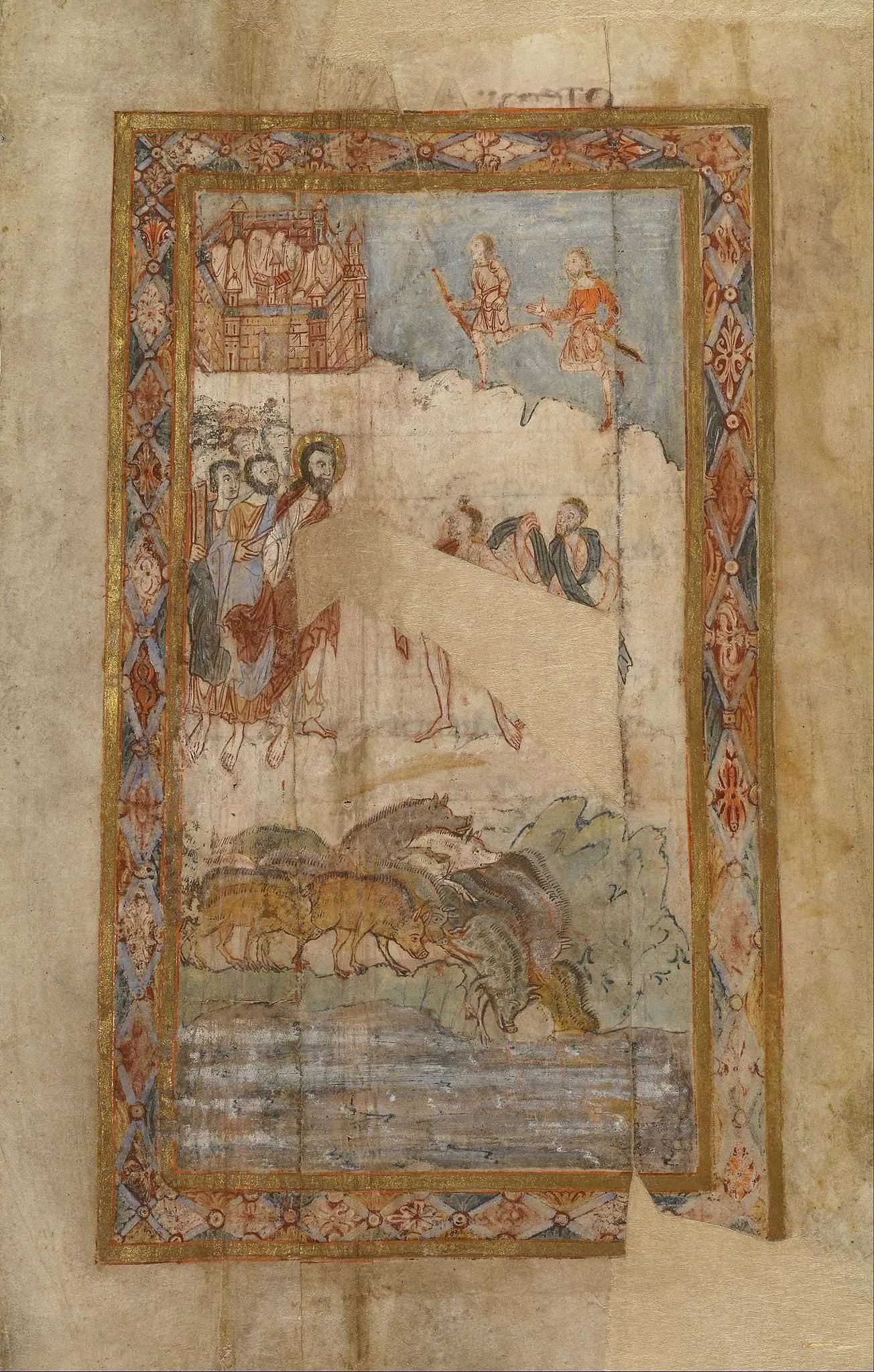
“And the unclean spirits came out and entered the swine; and the herd… rushed down the steep bank into the sea.”
Welcome to the practice of lectio divina through Kaleidoscope Bible Sharing. Each week, Kaleidoscope offers a new lectio based on the Revised Common Lectionary. You’ll read the passage three times, pausing to answer the questions (below) between each reading. As part of this practice, we at the Kaleidoscope Institute often reflect on the Holy Currencies—moving beyond Time, Talent, and Treasure to include the Holy Currencies of Time & Place, Gracious Leadership, Money, Relationship, Truth, and Wellness. These currencies name the sacred exchanges that sustain liberation—both in scripture and our lives. Look for themes of Truth and Wellness in this scripture.
This can be practiced alone or in a group. If you don’t have someone to reflect with, I’m here for you. I’ve offered my own reflection below and you can be my partner in this scripture. I invite you to share your reflection with us (email us at kscopeinstitue@kscopeinstitute.org).
First Reading: Listening to Scripture with Kaleidoscope Bible Sharing Questions:
Begin by reading the scripture slowly.
Let the words wash over you.
Notice what calls to you.What word, phrase, or image stands out to you?
Second Reading: Listening for the Spirit’s Invitation
Where in your life have you mistaken possession for presence?
Where have the voices of culture, shame, violence—even religion—taken up residence in a space meant for your own breath?
Third Reading: Offering Your Voice
Read the text a third time. Sit with it. Breathe with it. Reflect on the question: What is the Holy One calling you to do, be, or change?
Offered Reflections From Sarah and the Holy One she writes with, for all who are trying to remember their true name.
What word, phrase, or image stands out to you?
“The unclean spirits begged him.”
I also noticed that both the spirits and the pigs were called “unclean.” And I wonder now if that word was never just about the body or animals—but about systems. Legions of shame. Empires of control.
What’s really “unclean” here isn’t the possessed man.
It’s the possession itself.
The system that demanded he live among tombs.
The culture that would rather drown in pigs than witness a liberation it can’t control.
Where in your life have you mistaken possession for presence?
Where have the voices of culture, shame, violence—even religion—taken up residence in a space meant for your own breath?
This question is tender, and hard.
I’ve spent much of my life unlearning shame, especially around my body. I remember once walking in the heat of summer, sweating, uncomfortable, wearing a cardigan over my tank top—because I couldn’t bring myself to take it off. Somewhere deep inside me, I heard the voice of someone from my childhood, telling me that bare shoulders were “asking for something.” That I should be ashamed. That I should hide.
It wasn’t God who taught me that.
It was culture.
It was fear wearing a holy mask.
It was a kind of haunting.
And that’s just one example.
As a young mother, I was nursing my baby when another woman close to me suddenly criticized my body—harshly, shamefully (and while in my own home). Later, that woman admitted they were trying to hurt me, and didn’t know why.
That’s what possession can look like.
When shame speaks through someone in a voice not entirely their own.
When harm is inherited.
When silence is survival.
What is the Holy One calling you to do, be, or change?
We are called to confront the voices that do not belong in our bodies.
To unmask what culture told us was sacred, but was actually shackling.
To stop living among the tombs of someone else’s fear.
Sometimes that starts with a single act of vulnerability.
Writing a letter.
Telling a story.
Naming the wound.
In that moment with that woman in my house, my oldest child was watching, listening. And in that moment I stopped the journey of shame through my line. It lives in my body in how I flinch sometimes, but it will not be passed down to my children.
I grew up in a household that once told me that there could be demons lurking in the dark. But I never saw them there.
The demon that haunted me was not a horned creature in the closet. But shame culture wearing the face of someone I once trusted to guard the door.
That moment at my kitchen table? That was the haunting.
The moment when I stood up to shame in front of my children? That was exorcism.
When I prayed with the Holy One about this, this is what was whispered
Sometimes possession is not some foreign invasion.
Sometimes, it’s something passed down.From mother to daughter.
From church to child.
From patriarchy to every body that’s tried to stay soft in a world that demanded armor.We are not called to drown in shame.
We are called to remember our names.
We are called to come home to our own bodies.
Author’s Note
"Will you help pass the basket for Kaleidoscope?
You can become a paid subscriber to our Substack or donate directly here.
Your generosity fuels the work of the Kaleidoscope Institute—including scholarships for facilitators like me (my own training was made possible by donors like you, and I’m so grateful!). It’s an honor to weave hope and joy into the world alongside you.
Oops! Kscopeinstitute@kscopeinstitute.org
There was a t missing in your iteration but I was lengthily inaccurate in mine. Sorry.
Dear Sarah, firstof all, public service announcement : I noticed a missing "t" in the email address you shared. It would be kaleidoscopeinstitute@kaleidoscopeinstitute.org, I think.
Second, I have a daily journaling practice I'm about to take up this morning (it's still pretty early in Oregon) and I thank you and the Holy One with whom you write for the question about what possesses me. Your sharing enriches my searching today. 'Grace upon grace. '